Watermarking Is A Wake-Up Call
The Executive Summary:
On August 11, 2026, Anthropic announced that every piece of text Claude generates now carries an invisible, machine-readable watermark. The policy applies worldwide, with no opt-out, whether you use the API, Claude.ai, Claude Code, Claude Cowork, or Claude through AWS, Google Cloud, or Microsoft Foundry.
Claude's text watermark is a statistical signal embedded directly into the text at the model level, applied globally across all Claude products and cloud integrations as of August 2026. It travels with copy-paste and may survive editing. Anthropic says a detected mark indicates content was "processed by Claude," not necessarily authored by it. There is no opt-out.
This raises the question once again: How much of your business and its workflows do you really own? Do you have the control and optionality where it matters?
Tech platforms making unilateral decisions
We’ve seen this before: Facebook, Google, Youtube … Have all at one time or another made unilateral decisions that have directly impacted media companies. Now Anthropic is showing the same muscle. Anthropic's documentation says a detected watermark indicates that content "may have been processed by Claude."
To be clear, these are not 1:1 analogies: the ways Facebook, Google, Twitter, Instragam, et al. made changes to their algorithms and platforms were generally in ways meant to benefit their own platforms at the behest of publishers and other media companies. It's hard at this point to see how this watermarking change benefits Anthropic, unless you believe that their "Check if this content is AI generated" API is also a means of collecting new training data.
But it is a wakeup call to publishers and other organizations, who now have to ask: how critically dependent are we on this tech provider?
Consider a journalist who posts an interview transcript as part of an article, and runs it through Claude for a quick grammar pass. Now the audience may think the entire interview was faked. If any of that output is scanned, it returns the same signal as a document Claude wrote wholesale.
Publishers face a specific exposure. The Reuters Institute's 2026 Digital News Report found that only 20% of audiences trust news found in AI answers, and audiences already trust AI-labeled content less. A newsroom that uses Claude for transcription, translation, or copy-editing now risks every article carrying a machine-readable "AI touched this" flag that a scanner cannot distinguish from full AI authorship. Editors cannot defend what they cannot see, and this watermark is invisible to them.
How it works, why you can't remove it
The watermark is statistical rather than a tag appended to a document. The model slightly biases its token choices toward a pattern a detector can identify across enough text. The output still reads normally, while the signal can remain after copy-paste and some editing.
The watermark is probabilistic and survives some editing. Anthropic hasn't published the detection spec yet, so the exact durability threshold isn't public. What is clear is that the mark doesn't distinguish between "Claude wrote this" and "Claude touched this." Enterprises will have to manage that distinction themselves.
Because the mark is embedded at the model level, it cannot be removed by the platform you access Claude through, the way text is edited afterward, or any enterprise setting. It is a property of the output itself.
It's not Anthropic's fault
To reiterate and be clear here, we do not think Anthropic is at fault here. They are merely responding to EU legislation, and other model providers have signaled that they will soon follow (OpenAI especially).
We just think that it highlights a strategic stance that is becoming increasingly problematic for companies, especially those based in the US: that the model provider is tied to the business infrastructure (the "harness") that companies use to put models to work.
In other words, there are lots of good reasons to disclaim when content (or work output) has been generated by AI. We just think that the final decision for that should be with the company, not with the model provider. When your harness is entirely tied to one provider (i.e. Anthropic), you do not control that decision.
Companies should be able to have more control over the inputs to their work outputs. The utility does not control what you do with its electricity.
Tokenmaxxing & watermarks vs. Open-weights
Claude is already the most expensive frontier model in most enterprise stacks, and teams burning budget on workflows that never needed a frontier model now learn their premium-priced output also carries a hidden vendor tag.
It is becoming increasingly more attractive to consider open-weight models, which can be as much as 29 times cheaper, and give you the optionality on whether or not the situation justifies AI disclaimers or not. This is especially true when open-weight models are just as good or better for practical work (not everything needs a howitzer).
See for yourself: open-weight models
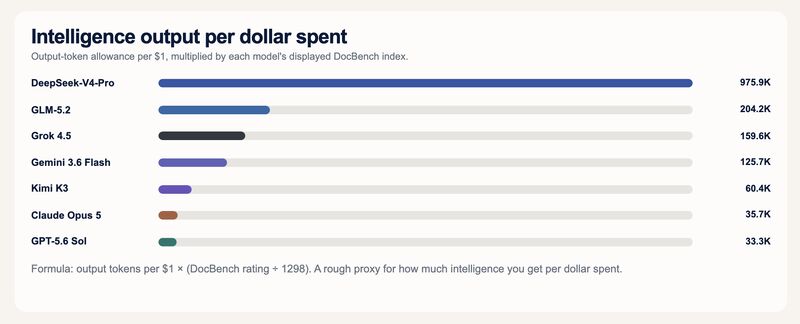
We've built The Practical Work Benchmark, which contains both an interactive experience and also a report on the top seven leading models today. In the interactive experience, you can select 3 different "normal person" workflows—generating a PDF, prepping for your day, analyzing some data—and see the outputs from each of the seven leading models.
The whole point of this exercise, and also what makes it difficult, is that the outputs are hard to distinguish. They are largely pretty incredible. Which begs the question: why pay $30 dollars for something that costs $0.87? If you have 1,000 employees using AI daily, that gets incredibly expensive.
Independent harnesses give you choice
The elvex platform doesn't remove watermarks. Claude output processed through elvex carries the same mark it would carry anywhere else. But we give you choice.
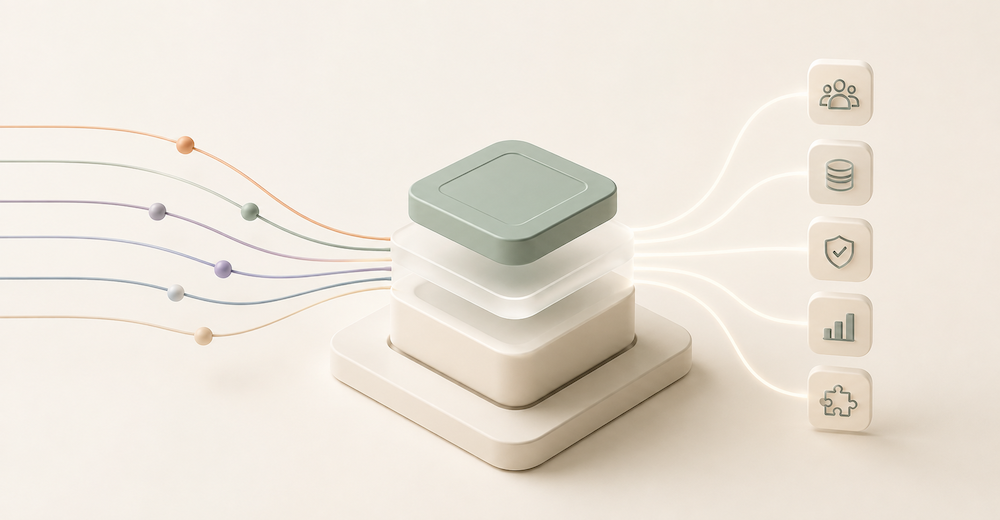
Model-independent architecture addresses what comes before that question. When your workflows, agents, prompts, permissions, and organizational context live in an independent layer, switching models becomes a routing decision. You point the workflow to a different model while keeping the workflow itself, the institutional knowledge built into it, and the governance layer.
Organizations can build their AI layer in a way that preserves their options. Provenance and governance, including audit logs, model attribution, and human review gates, should remain under the organization's control and configuration.
The practical question right now
For organizations running AI workflows at scale, the watermark announcement creates a reason to determine which parts of their AI capability they own and which parts depend on a vendor that can change the terms. The answer depends on where the prompts, context, and workflows live. They may sit inside a model provider's product, or in a layer dedicated to independence and flexibility. A blind model taste test can show how different models perform on your real work before you commit workflows to any one of them. Try it here.
Related posts
.avif)
.avif)
Transform your workflows today
Learn how we can help you modernize your business.