What Is an Enterprise AI Harness?
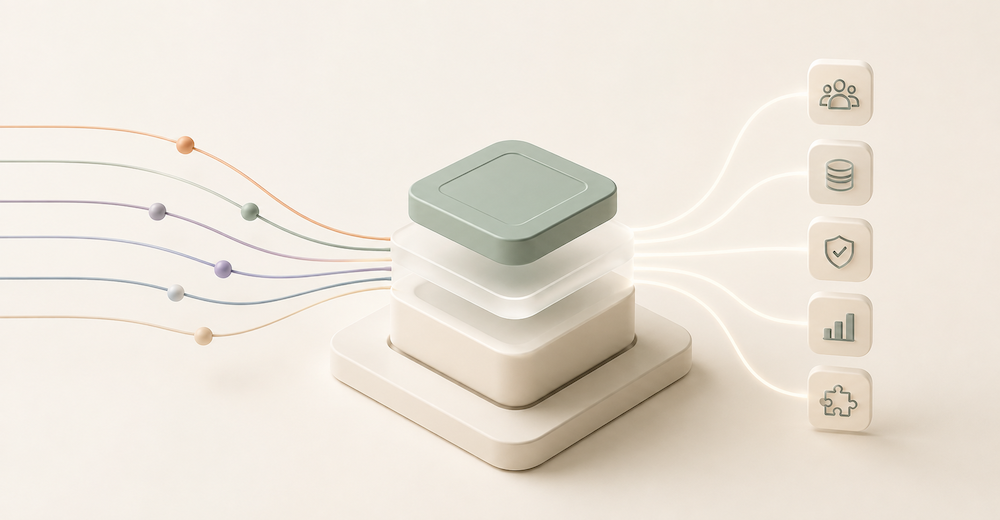
You have already used an AI harness: it's the "app" you use to interact with large language models. Every interaction with an AI model happens through some form of harness. ChatGPT.com, Claude Code/Cowork, Gemini inside Google Search, Glean, elvex, Hermes, and OpenClaw are all harnesses. There are many, many more examples.
An enterprise AI harness is the software layer between a company and its employees using AI models.
Because it is fundamentally built for companies, an enterprise harness is different from regular AI harnesses in several key ways, largely centered around functionality that helps standardize, scale, and govern AI use across hundreds (or thousands) of employees doing team-based work, instead of the more individual-focused harnesses people are more familiar with. These functionalities include sharing outputs of work, sharing agents/"skills" and workflows, data integrations, oversight layers for permissions and analytics, and data safeguards.
The model is a commodity input, like electricity. The harness is the system that puts it to work, and where differentiation lies.
What a harness is
A harness sits on top of a model and controls how it works. For an individual, it has four components: a system prompt that governs the model’s behavior, tools it can call such as web search, code execution, and email, an agentic loop that lets it assess and retry its work, and a translation layer that allows the same setup to work across whatever model you are trying to use.
The technical community already accepts the agent harness. Claude Code popularized it, and open-source harnesses such as OpenClaw, OpenCode, Hermes, and Pi made it a movement. Your forward-deployed engineers probably use one daily.
Why companies are moving from agent harnesses to enterprise harnesses
Nearly five times more individuals report meaningful AI productivity gains than organizations report company-wide ROI. Individual gains that remain in personal chat histories cannot compound into organizational capability.
Our own platform data shows the effect of a stronger harness. Across 3.8 million enterprise messages on elvex, messages shortened from 160 to 125 characters (i.e., became less complex prompt engineering) as the harness took on more of the work. At the same time, tasks became harder, rising from 5 to 8.5 model requests per conversation, and reported satisfaction with work outputs increased from 50% to 80%. The users stayed the same while the harness improved. At scale, a system that helps one person can help a thousand people and become infrastructure for the company.
What an enterprise AI harness actually does
Six functions define the category and provide a practical framework for evaluating vendors.
The access layer: where work happens
The access layer is the surface employees touch. These features all power purpose-built agents for jobs such as HR policy questions, sales operations, and financial analysis. It includes
- Input & output functionality: chat, with file attachments, document and draft generation, data analysis, image generation, voice input, mobile access, and Slack.
- Connectivity: integrations and datasources to pull live data.
The access layer must be good enough to beat shadow AI. Governance has little practical value when the sanctioned interface is worse than the free alternative. UX details such as depth modes for quick or deep answers, agent discovery and search, bookmarking, and conversation search determine whether employees adopt a deployment or not. It simply has to be as good and convenient and approachable as the ChatGPT app on an employees phone.
Model selection and the translation layer
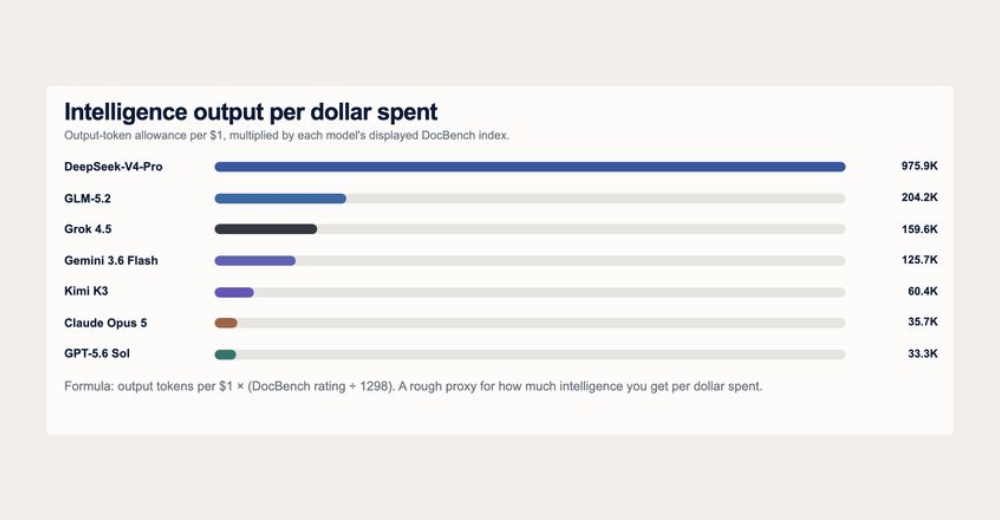
An enterprise harness is designed to work with practically any model you want, behind protected legal agreements and firewalls to prevent data leakage and training. Whether it's OpenAI, Anthropic, Google, or their just-as-capable and 95% cheaper options coming from open-weight providers such as DeepSeek and Kimi, the whole idea is that your organization is not locked in to one frontier lab's billing choices.
The economics have changed significantly in two years. In early 2024, the benchmarks that matter for enterprise work placed frontier models near 86 and open-weight models near 72. By early 2026, open-weight models had reached 95 and frontier models 96, leaving them one point apart. For the drafting, research, summarization, analysis, classification, and question-answering work people do with AI every day, the bill is the only practical difference between closed and open models, while the price difference is substantial.
Three mechanisms support effective model selection:
- Normalized prompting: the same prompt works across models, so teams can change an agent’s model through configuration.
- Per-agent model selection with intelligent defaults: cost-insensitive hard problems go to frontier models, while high-volume routine work goes to open-weight models. This strategy can cut AI costs dramatically without sacrificing quality.
- Routing of work to the correct agents: When asking work to be done, the platform should use context and other built-in rails to direct the request to the agent built for the task (that the user has access to).
This also reduces the delay between a new model’s release and its adoption. When a better model ships, and one always does, the company can make it available immediately.
Organizational context: the "compounding asset"
Context allows a model to understand the company instead of starting from zero in every conversation. A consumer harness keeps that context in one person’s chat history. An enterprise harness compounds it at three levels:
- Personal context: an employee’s role, preferences, working style, and ongoing projects. This is similar to "Memory" you might be familiar with in consumer harnesses.
- Team and project context: shared workspaces, called Spaces in elvex, with persistent and updating background information, pinned agents, and datasources.
- Company context: terminology, positioning, policies, and institutional knowledge injected wherever relevant.
- Context-based discovery: When a person needs a job to be done, and there's a public resource already constructed in your workspace that solves it, the platform should connect the dots on behalf of the user based on the context embedded in their request, their personal context, and the context of the resource being used. This is as opposed to having to manually share it when the situation arises.
The harness should automatically extract the relevant parts of this system of context and inject it into each relevant conversation while keeping it editable and governed. Importantly, there's a hierarchy here: company context trumps personal context, which allows for broad scale directional guidance. Strict controls rarely happen at the context layer, but generalized broad scale guidance can be done via context: company branding, terminology, instructions on system access, and similar "every-employee" type items can live here.
Other people’s work adds another layer of organizational context in between personal and company context. Shared threads, agents, and workspaces allow a teammate’s breakthrough to become someone else’s starting point.
Orchestration: from chat to completed work
Orchestration connects AI conversations to business operations:
- Agent delegation: agents call other agents, each with its own tools, instructions, and data access.
- Scheduled runs: recurring agents operate on cron cadences to produce daily pipeline reports, weekly syntheses, and Monday-morning briefings.
- Integrations as an action layer: agents send emails, update Salesforce records, post to Slack, create Notion pages, and call MCP servers.
- Artifacts: reports, decks, spreadsheets, and other durable, permissioned outputs live beyond the conversation.
In other words, chat provides the interface while orchestration gets the work done.
Teamwork: agents and workspaces as shared infrastructure
An enterprise harness supports multiplayer work by default. Agents, datasources, threads, and outputs can become shared, permissioned assets for the team instead of remaining in one person’s account.
- Agents the team can share: one person builds an effective agent, and the whole team can use it, instead of being recreated by each employee.
- Workspaces for teams and projects: Spaces provide composable environments with their own context, pinned agents and datasources, and hosted threads. People and agents thus work from the same background. A common use case here would be "the Marketing Team Space" with the 25 agents used by the marketing team, or the "Q1 QBR Space" with the documents and agents for the team putting together the QBR. The point is: multiple agents, multiple documents, multiple people, with only one thing you need to bookmark, and context embedded to orchestrate how its all used.
- Threads and artifacts with lasting value: a colleague’s conversation, report, or analysis becomes a durable, permissioned asset that outlives the chat that produced it.
This model addresses the central limitation of what we call Harness 1.0. The first generation of AI tools scaled per user, leaving context and capability dependent on each individual’s setup and chat history. Sharing remains controlled at the resource level, with viewer, editor, and owner roles.
Governance, spend, and risk control
The same permissions that support collaboration also provide governance. This governance allows companies to deploy AI consistently across the workforce:
- Roles and permissions: consumer/member/creator/admin roles, per-resource access control, SSO/SAML, and user groups.
- Audit logs: full prompt and response history, model provider records, and cost attribution for each user and team.
- Spend visibility and budget control: per-model and per-team cost tracking gives companies visibility before the invoice arrives.
- Security posture: SOC 2 Type II and HIPAA readiness, encryption in transit and at rest, zero-retention database access, and ephemeral code sandboxes.
- Human-in-the-loop approvals: the harness can act while humans authorize consequential actions.
A security team should be able to ask, “What did the AI do last week?” and get a complete answer. But this also applies to management at any level; if the function of management is to keep people working effectively, and AI is being used for essentially all work, the platform needs to make it easy to encourage good use while not crossing Orwellian boundaries. One of our customers two years ago had one of the top ten most used agents at their company end up being one guy's personal "help me write a fantasy novel" agent. More power to him, but management needs to know where thousands of dollars in token costs are going. (They intervened).
Enterprise harness vs. buying ChatGPT Enterprise or Claude Enterprise
ChatGPT Enterprise and Claude Enterprise are frontier-lab harnesses. They are real harnesses and genuinely good products, especially for individual power users. But their design reflects the needs of the companies that built them.
A lab harness supports the lab’s model business. Its design decisions naturally favor one vendor’s models, roadmap, and pricing because those incentives shape the product. When the best next model comes from a competitor, a lab harness has no reason, and increasingly no mechanism, to offer it. And when the difference in cost is .... substantial .... the business logic of using an independent harness is undeniable.
Who’s already building harnesses (and why most companies don't)
Uber, Shopify, Cloudflare, and Ramp all run internal AI harnesses. These custom-built layers route across models, inject company context, and give thousands of employees governed access to AI.
Building your own requires significant investment. Each of those platforms needed a dedicated platform-engineering team staffed with scarce, expensive talent. Most companies with 500–5,000 employees cannot justify that headcount for internal tooling. Engineering time spent building, maintaining, and updating custom AI harnesses also comes directly from time available for the company’s core product. The architecture is proven, but most companies do not have the people required to replicate it.
Purpose-built enterprise harness platforms give companies the outcome Uber and Shopify engineered for themselves without requiring an internal platform team. Deployments have produced measurable results:
- Embark Consulting achieved 72% workforce AI penetration, reduced meeting-prep time by 60%, and built 500+ AI apps through non-technical consultants.
- WordPress VIP reached 58% weekly active usage across revenue teams, with 39 team-built agents and 100+ people onboarded in two months.
- A national asset management firm cut contract-review time by 80% using a system built by its own people, with no engineers hired.
- McClatchy runs 12,000 AI workflows per month across 400+ employees.
- Head-to-head rollouts have produced 3–5x higher adoption than Copilot or ChatGPT Enterprise.
- A 2,000-person MedTech firm reduced costs by 50% versus Copilot.
Companies including The New York Times, Boston Globe, and McClatchy run their AI this way.
What to look for in an enterprise AI harness
Use these eight questions in roughly this order when evaluating vendors:
- Does it offer model-agnostic routing, including open-weight models? Optionality provides the core value of a harness.
- Does organizational context compound? Personal, team, and company-level context should persist and improve beyond per-user memory.
- How deep is the governance model? Audit logs, roles, per-resource permissions, and SSO/SAML provide the controls security teams will demand. Look for SOC 2, HIPAA, PII redaction, and zero-retention data handling.
- Can you track and control spend for each model and team? You should know what every team and model costs, so you can control the invoice.
- Will employees choose the interface over shadow tools? You can't govern a tool they are using on the side.
- How does it support multiplayer work? Look for shared agents, workspaces, and outputs designed as team assets from the start.
- What can it orchestrate? Evaluate delegation between agents, scheduled runs, and integrations that take action in your systems.
- What enablement partnership does the vendor offer? Does their support actually go the distance, or are they trying to minimize interaction.
Frequently asked questions
What is an enterprise AI harness?
An enterprise AI harness is the software layer between a company and its AI models. It provides the interface employees use, routes work across models, compounds organizational context, provides team projects and workspaces, integrates with company data, and supplies the governance, analytics, and cost controls required to run AI safely at company scale.
What’s the difference between an AI harness and an AI platform?
“AI platform” is an older, broader term that covers everything AI powered, from model-serving infrastructure to advanced analytics to chat workspaces. “Harness” describes the model-independent control plane between a company and large language models, and generally is something that allows you to build new workflows. Every enterprise AI harness is an enterprise AI platform.
What’s the difference between an agent harness and an enterprise AI harness?
An agent harness equips one person to use a model through a system prompt, tools, an agentic loop, and a translation layer. An enterprise AI harness applies those same single-player concepts across a business, adding shared context, agents and workspaces, governance and audit, spend control, security, reliability, and an interface non-engineers can use.
Do I need a harness if I’m only using one model provider today?
You don't really have an option on "do I use a harness or not," because interacting with a model requires a harness. But an independent one is a good decision. Prompts, agents, context, and employee habits accumulate in whichever layer contains them. When that layer belongs to a frontier lab’s app, each time you use it you are only increasing your future potential switching cost.
Is building an internal AI harness realistic for a mid-market company?
It is technically realistic and rarely economical. Uber, Shopify, Cloudflare, and Ramp built internal AI platforms with dedicated platform-engineering teams. A company with 500–5,000 employees generally cannot justify that headcount for internal tooling. Engineering time spent building and maintaining custom AI harnesses also reduces the time available for the core product. Purpose-built harness platforms deliver the same outcome without requiring the company to build the platform itself.
How does an enterprise harness reduce shadow AI?
A harness reduces shadow AI by giving employees a better, more useful product. Shadow AI flourishes when the sanctioned tool is worse than the free alternative. A harness gives employees frontier-model access, company context, and useful agents inside a governed environment.
How do teams share agents and AI work inside a harness?
Each resource can carry viewer, editor, and owner roles, giving teams room to collaborate while preserving control. Teams can then also create Spaces, which is a grouping of multiple resources: agents, datasources, artifacts, teammates, and more. These Spaces are loaded with context that instructs people and agents using the Space on how the embedded resources should function, so an employee just needs to show up and say "Go."
How does a harness relate to an AI gateway?
A gateway routes API calls between applications and model providers, providing infrastructure for engineers. A harness governs the full relationship between employees and AI through its interface, context, routing, teamwork, governance, and spend controls. The two layers serve adjacent functions, and some companies run both.
The point of a harness
A company rents its AI models and uses a harness to control how employees access them, how company context reaches them, and how easily they can be replaced when a better option ships. Model performance converged while the price difference remained. The companies that get durable value from AI in 2026 will use a harness that treats each model as a replaceable component.
The best harness is the one employees can use without thinking about the infrastructure behind it. If you’re evaluating an enterprise harness, run your own workload through each option. Compare the output quality and the invoice. See our study on 3.8 million messages, illustrating the impact of an enterprise harness.

Related posts


.avif)
Transform your workflows today
Learn how we can help you modernize your business.