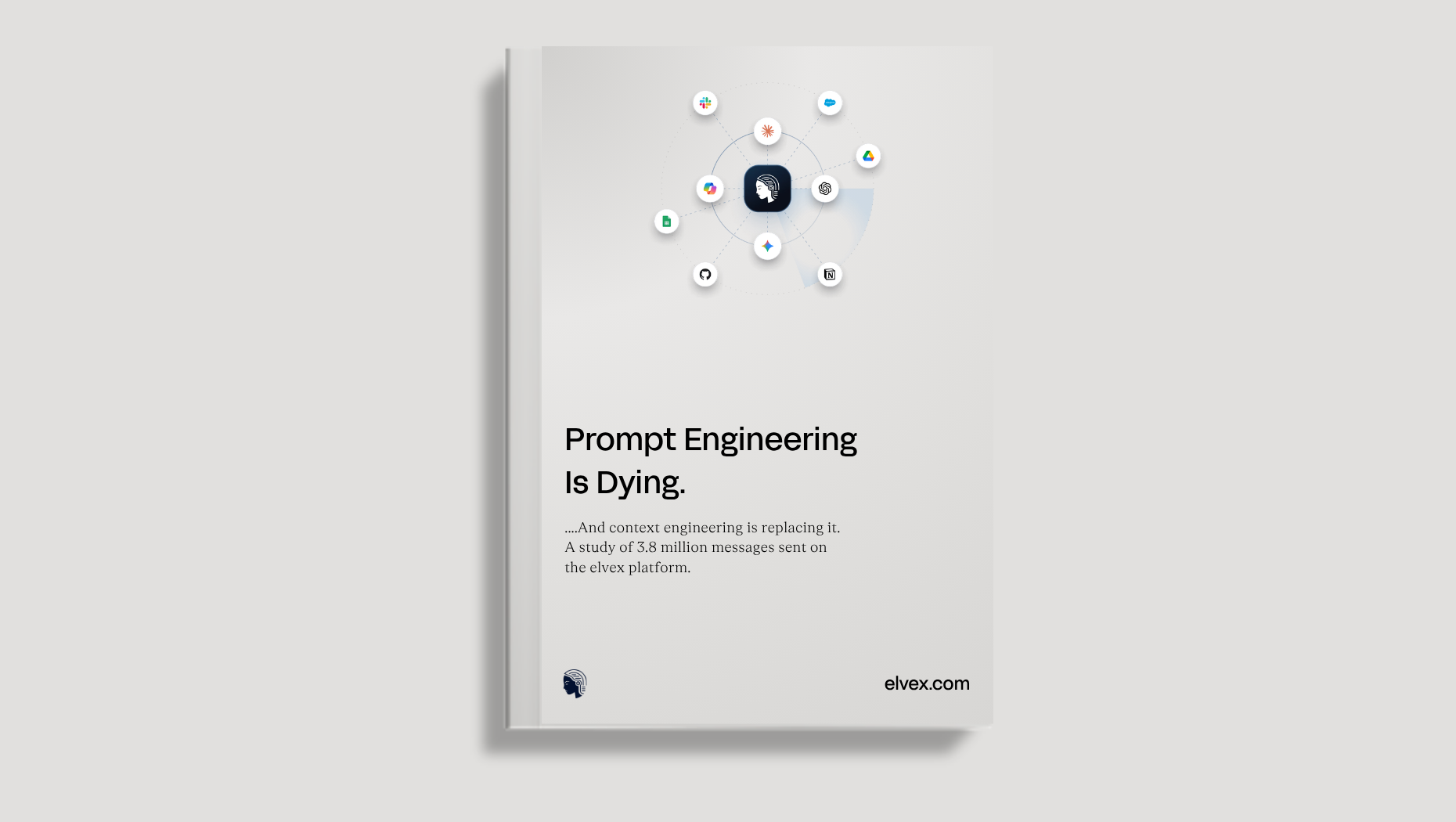
Prompt Engineering Is Dying
Context Engineering Is Replacing Prompt Engineering.
Your organization has run the workshops. You've published the internal prompt guides. You've appointed AI champions. And yet, the results are still concentrated in the same 10% of power users who were already comfortable with the tools.
The problem was never the prompts. It was the platform.
A study of 3.8 million messages sent on the elvex enterprise AI platform makes the case plainly: prompt engineering is dying and it never truly worked at enterprise scale. Two platform-level capabilities are replacing it: context engineering and agentic planning. Organizations that make this shift will see a fundamentally different transformation curve.
Inside This Guide, You'll Learn:
Why "AI Adoption" Is Not Transformation
Most enterprise AI deployments produce attendance metrics, not capability metrics. Tools get used; work doesn't actually change. This guide explains why AI knowledge doesn't compound across organizations the way traditional software knowledge does and why the standard response (more training, better prompts) treats the symptom rather than the cause.
What Context Engineering Actually Is
Context engineering is the platform's ability to automatically supplement a user's message with relevant company knowledge, prior workflows, and output formats before the request reaches the model. When the platform carries the context, users don't need to be experts to get expert-level results.
How Multiplayer Context Engineering Changes the ROI Equation
When one employee figures out the right approach to a problem, the platform captures what they built and makes it available to everyone else. AI competency spreads across the organization not because everyone went through training, but because the platform carries institutional knowledge forward.
What the Data Shows: 3 Charts from 3.8 Million Messages
After elvex rolled out context engineering and agentic planning, three things happened simultaneously:
- Users submitted shorter, simpler messages; median message length dropped from ~164 characters to ~127
- They pursued more complex, multi-step tasks; average LLM requests per conversation rose from ~5 to more than 8
- Satisfaction climbed from roughly 60% to nearly 79% across all users, not just power users
Why Agentic Planning Unlocks Work That Prompt Skill Never Could
Earlier AI systems required users to break down complex tasks themselves, manage sequencing, and stitch outputs together. That process reliably stayed in the hands of power users. Agentic systems receive a large task and decompose it into smaller subtasks; each handled more reliably than the whole. Complex work becomes accessible to everyone.
Why Governance Becomes More Important, Not Less, as AI Gets More Capable
As AI handles more work autonomously, the chatbot as a primary interface declines and visibility into what the system is doing becomes the critical requirement. Platforms built for governance from the start are better positioned for this. Audit logs, analytics, and testing capabilities aren't overhead; they're the foundation that makes broad transformation possible.
The Platform Questions Worth Asking
If your current AI investment is producing power-user results instead of org-wide ROI, this guide gives you the specific questions to evaluate whether your platform can actually scale; including whether it loads business context automatically, whether agents can be shared across teams, and whether institutional AI knowledge is preserved when employees leave.
"Millions — if not billions — of dollars have been wasted training employees how to prompt engineer, with very little ROI to show for it. The harnesses are getting smart enough that that's now unnecessary."
— Sachin Kamdar, CEO, elvex
Download the Study
See the full data behind the shift from prompt engineering to context engineering and what it means for how your organization should be evaluating and investing in enterprise AI.
Context Engineering Is Replacing Prompt Engineering.
Your organization has run the workshops. You've published the internal prompt guides. You've appointed AI champions. And yet, the results are still concentrated in the same 10% of power users who were already comfortable with the tools.
The problem was never the prompts. It was the platform.
A study of 3.8 million messages sent on the elvex enterprise AI platform makes the case plainly: prompt engineering is dying and it never truly worked at enterprise scale. Two platform-level capabilities are replacing it: context engineering and agentic planning. Organizations that make this shift will see a fundamentally different transformation curve.
Inside This Guide, You'll Learn:
Why "AI Adoption" Is Not Transformation
Most enterprise AI deployments produce attendance metrics, not capability metrics. Tools get used; work doesn't actually change. This guide explains why AI knowledge doesn't compound across organizations the way traditional software knowledge does and why the standard response (more training, better prompts) treats the symptom rather than the cause.
What Context Engineering Actually Is
Context engineering is the platform's ability to automatically supplement a user's message with relevant company knowledge, prior workflows, and output formats before the request reaches the model. When the platform carries the context, users don't need to be experts to get expert-level results.
How Multiplayer Context Engineering Changes the ROI Equation
When one employee figures out the right approach to a problem, the platform captures what they built and makes it available to everyone else. AI competency spreads across the organization not because everyone went through training, but because the platform carries institutional knowledge forward.
What the Data Shows: 3 Charts from 3.8 Million Messages
After elvex rolled out context engineering and agentic planning, three things happened simultaneously:
- Users submitted shorter, simpler messages; median message length dropped from ~164 characters to ~127
- They pursued more complex, multi-step tasks; average LLM requests per conversation rose from ~5 to more than 8
- Satisfaction climbed from roughly 60% to nearly 79% across all users, not just power users
Why Agentic Planning Unlocks Work That Prompt Skill Never Could
Earlier AI systems required users to break down complex tasks themselves, manage sequencing, and stitch outputs together. That process reliably stayed in the hands of power users. Agentic systems receive a large task and decompose it into smaller subtasks; each handled more reliably than the whole. Complex work becomes accessible to everyone.
Why Governance Becomes More Important, Not Less, as AI Gets More Capable
As AI handles more work autonomously, the chatbot as a primary interface declines and visibility into what the system is doing becomes the critical requirement. Platforms built for governance from the start are better positioned for this. Audit logs, analytics, and testing capabilities aren't overhead; they're the foundation that makes broad transformation possible.
The Platform Questions Worth Asking
If your current AI investment is producing power-user results instead of org-wide ROI, this guide gives you the specific questions to evaluate whether your platform can actually scale; including whether it loads business context automatically, whether agents can be shared across teams, and whether institutional AI knowledge is preserved when employees leave.
"Millions — if not billions — of dollars have been wasted training employees how to prompt engineer, with very little ROI to show for it. The harnesses are getting smart enough that that's now unnecessary."
— Sachin Kamdar, CEO, elvex
Download the Study
See the full data behind the shift from prompt engineering to context engineering and what it means for how your organization should be evaluating and investing in enterprise AI.
Transform your workflows today
Compared to DIY approaches, companies that use elvex are 60% faster at bringing LLMs to their employee’s work, with 4.3x higher adoption rates

.avif)
.avif)
