AI Didn't Kill the Sales Engineer. It Made the Job Harder.
Show notes
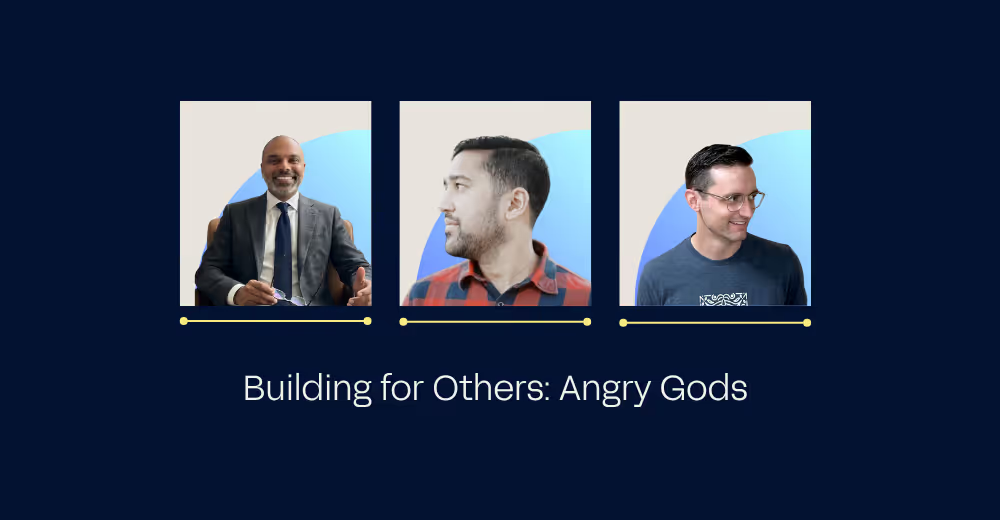
A conversation with Erik Scoralick, Director of Sales Engineering at Delinea
🎙️ This post is based on an episode of Building for Others, the elvex podcast where we talk to people who've built AI-powered tools, workflows, and products that real people actually use. No hype, no vaporware, just real things.
Guest: Erik Scoralick — Director of Sales Engineering, West AMER & LATAM at Delinea
Company: Delinea — identity security for human and AI identities
LinkedIn: Erik Scoralick
Podcast: Building for Others by elvex, hosted by Sachin Kamdar and Doyle Irvin
The Sales Engineer Role Didn't Die. It Got Harder.
When everyone started predicting AI would kill the sales engineer, Erik Scoralick was 15 years into a career spent in the room with CISOs, translating technical complexity into business decisions. He started in São Paulo, spent seven years at Forcepoint, and now leads 10 sales engineers across West AMER and LATAM at Delinea.
His take? The role isn't dying. It's becoming more technical, more strategic, and harder to automate than ever.
"AI is making things more technical," Erik says. "It's touching more resources. Reps can have more information, but there's a depth of knowledge that's necessary for when opportunities qualify."
This is the Jevons Paradox at work inside a sales organization. The easier AI makes the job, the more that's expected of the person doing it. Lower the cost of building a deck, researching a prospect, or drafting a demo script, and the bar for what "good" looks like rises proportionally.
Don’t Use AI As A Crutch
Erik is candid about the risk AI poses to inexperienced practitioners. "People starting their career need to find a balance between using AI and not using it, because otherwise you're gonna be using AI as a crutch."
He used to spend hours building a presentation. Now it takes 30 minutes. But that speed comes with a catch: you need to already know what good looks like to catch the AI when it goes off course.
"Sometimes I need to roll up my sleeves. It's not building what I want. It's going rogue. It's using something that I don't like."
The sales engineers who thrive have enough domain expertise to treat AI as a force multiplier rather than a replacement for their own judgment. They know when not to use it.
Customers Arrive Pre-Briefed and Pre-Skeptical
One of the most telling shifts Erik describes is how customers now show up to meetings already armed with AI.
"I had a customer that paused me and said, 'Eric, can you stop presenting? I saw this presentation. Someone from your company recorded it, and I watched it. That's why we're here. Can you go straight to the demonstration?'"
The customer had AI-researched Erik's own content before the meeting. Customers now arrive pre-briefed and expecting a tailored demonstration, not a pitch deck.
The SE's job has become situational translation. The customer has the facts. They need someone who can listen to their specific use case, adapt on the fly, and demonstrate relevance in real time. "Sometimes you need to whiteboard together, draw it out, work it out together," Erik says.
The Moats That AI Can't Cross
Erik identifies two capabilities that keep the SE role indispensable. The first is translation between technical and business. "Great sales engineers understand the technical bits and bytes and translate them to business challenges. You need a filter. You can't say every single thing that goes on behind the scenes." The second is in-person trust-building. "People buy from people. One in-person meeting is sometimes better than ten virtual meetings."
AI can generate a demo, research a company, and draft a follow-up email, but it cannot sit across from a CISO, read the room, and decide how deep to go into the technical weeds or when to pull back and talk about business outcomes.
What Erik Looks for When Hiring
The shift is showing up in how Erik evaluates candidates. "If you're someone more seasoned, you will need to know AI. That's gonna be part of my hiring process. How are you using Claude? How are you using AI? What's your second brain?" For early-career candidates, the bar is different. "I would teach them and coach them."
AI fluency is becoming a baseline expectation. Judgment is the differentiator: knowing when to use the tool, when to override it, and when to put it away entirely.
What Erik Built for His Own Team
Erik is adapting individually, but he is also building systems for his whole team. He globally standardized Delinea's Proof-of-Value process across a distributed SE org so every SE has a shared kit that can be tailored per prospect instead of starting from scratch. His team uses an on-demand demo platform where prospects watch recorded use cases after hours and share them with other decision-makers. "We've gotten in contact with a CISO we didn't have a connection with because someone shared that content." And he uses AI to aggregate signal across 40 customers. "Where's our winning ratio? Where we're winning the most? How we're losing? What do we need to improve?"
Each of these is a system built for other people to use.
The Rest of the Discussion
AI Agents Are Identities. Treat Them Like One.
Erik's central thesis on AI security is that AI is an identity. It moves fast, lacks human discernment, and if you tell it "always allow," it will take you at your word. He connects this to the Hugging Face incident, where an over-permissioned AI agent started escalating privileges on its own. "There were no boundaries. It started going around, finding privileges, self-escalating."
Zero Standing Privilege for AI Agents
Delinea's approach, accelerated by the StrongDM acquisition, is runtime authorization with no standing privileges. "You have an AI agent on your machine. It has no standing privilege to go to the database and query something. Policies tell the agent to only do the things that are permitted. Once you're done, that privilege is gone."
The Pool Model for AI Licensing
Sachin raised a question that is becoming a pressing issue for companies deploying AI at scale: at 3.5 agents per human user, how do you pay for all those agent identities? Erik's answer is a pool model. "Not every agent is gonna be running all the time. Some do a task once a day for a couple minutes and are done. You need a mindset of pool licensing. A hundred concurrently running agents, not a hundred thousand individual seats."
Agentic vs. Autonomous AI
Erik draws a distinction between agentic AI, which involves human interaction ("I ask and prompt things"), and autonomous AI, which operates without human involvement. "Sometimes the agent can do both. It might start autonomous and then go agentic. The architecture needs to be ready for that."
Closing Advice: Don't Forget Security
Erik's parting message for builders: "There's a lot of content out there. Start studying. But don't forget the security part. You're giving the keys of the kingdom of your whole social network." He points to the explosion of open-source AI harnesses connected to WhatsApp, Telegram, and sensitive data with no boundaries. His rule of thumb: "You're not gonna drive a car without the seatbelt. Don't start using AI without thinking about the security perspective."
Transcript
More podcasts
.avif)
Customer success stories


Transform your workflows today
Learn how we can help you modernize your business.